
Introduction to Philosophy
The term philosophy derives from the Ancient Greek words φίλος (philos, “love”) and σοφία (sophia, “wisdom”), literally “love of wisdom or “love of knowledge”.
- In the Indian tradition, the equivalent term is darśana (दर्शन), denoting “vision” or “spiritual sight” (ज्ञान चक्षु, दिव्य चक्षु), with chakṣu (चक्षु) meaning “eye” in Sanskrit.
Wisdom and Its Manifestation
In Sanskrit, buddhi (बुद्धि) or viveka (विवेक) denotes the capacity to discern between right and wrong. True knowledge cultivates humanity and ethical conduct, as expressed in the verse:
विद्या ददाति विनयं विनयाद्याति पात्रताम् ।
पात्रत्वाद्धनमाप्नोति धनाद्धर्मं ततः सुखम् ॥
Historical Timeline: Cosmos, Life, and Humanity
Age of the Universe & Solar System:
Modern cosmology estimates the universe’s age to be about 13.8 billion years (1380 crore).
- The age of the universe is estimated by analyzing the cosmic microwave background radiation and the universe’s expansion rate using modern cosmological models.
- The Solar System formed much later, about 4.6 billion years ago (460 crore).
- This estimate is based on the study of physical samples from within the solar system, such as meteorites, Moon rocks, and Earth’s oldest materials.
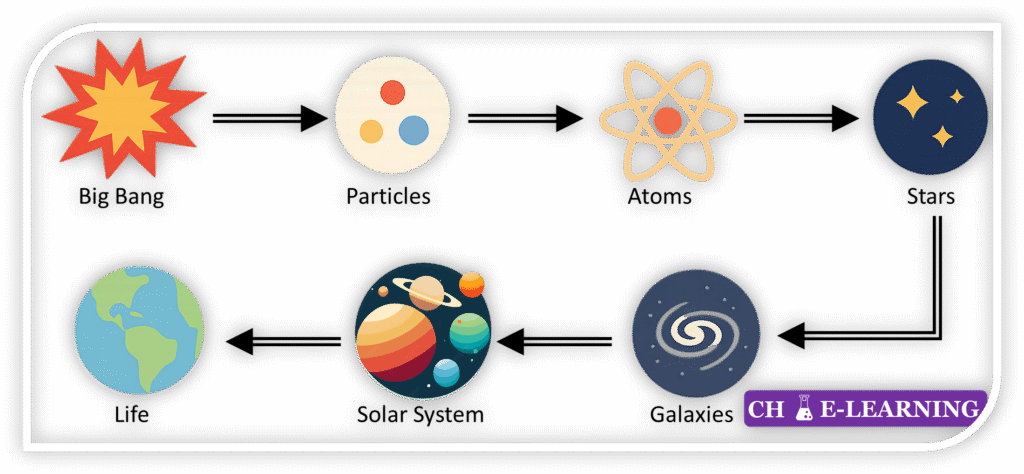
Origin of Life (Species):
Life on Earth emerged around 3.7−4 billion years ago (370-400 crore) in the form of a simple microorganism (prokaryotic प्रोकैरियोटिक).
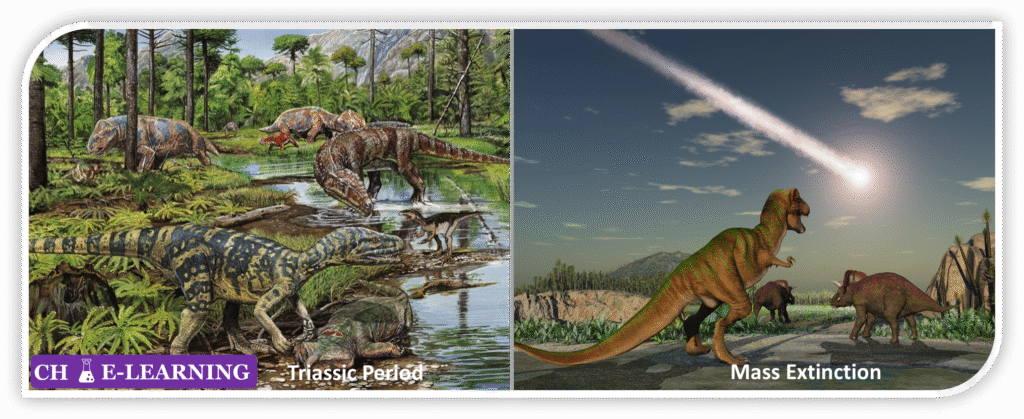
- Dinosaurs first appeared during the Triassic (ट्रायसिक) period around 230 million years ago (23 crore) and dominated by terrestrial ecosystem throughout the Jurassic and Cretaceous (क्रेटेशियस) periods until about 66 million years ago.
- Their sudden disappearance is attributed to a mass extinction event most likely caused by an asteroid impact.
- In Indian tradition, sanātana paramparā (सनातन परम्परा) speaks of 84 lakh yonis (life forms) in cycles of rebirth.

- Modern biology, however, has identified only a few million living species, with many yet undiscovered.
Human Evolution: Key Milestones:
Primates:
Shortly after the extinction of dinosaurs, during the rapid diversification of mammals, primates originated about 66 million years ago (6.6 crore).
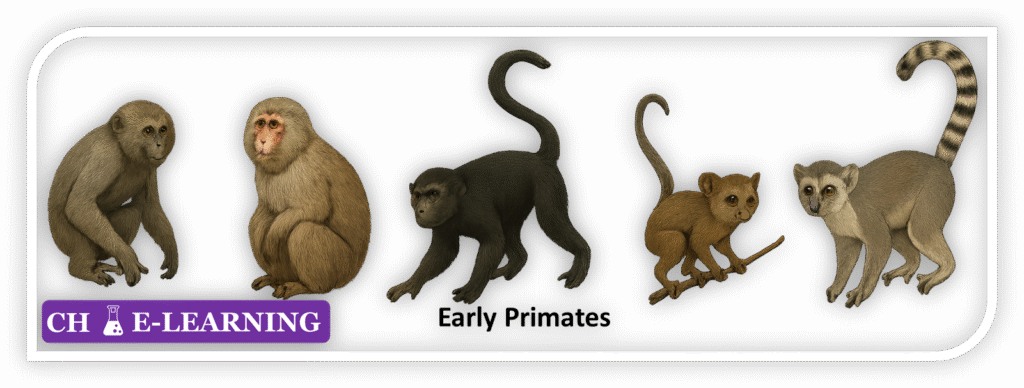
- Later, around 7-6 million years ago (0.7 crore), primates split into two sister clades: the ape lineage and bipedal hominin lineage.
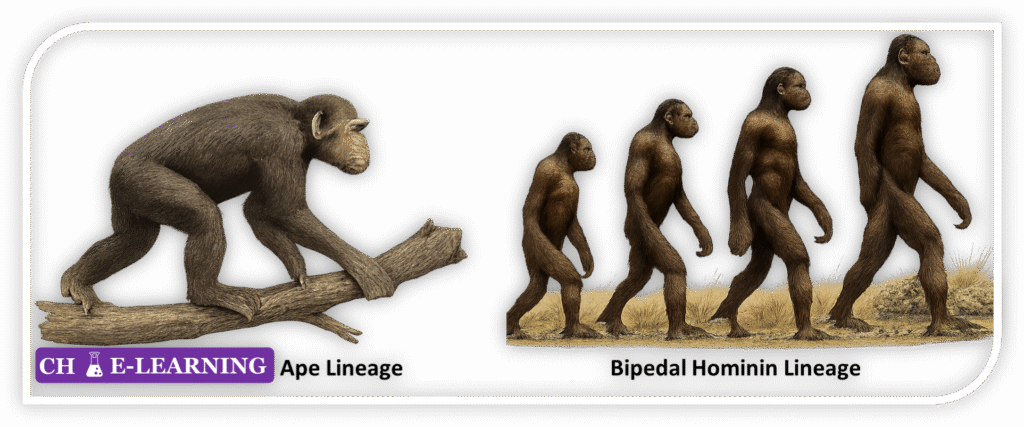
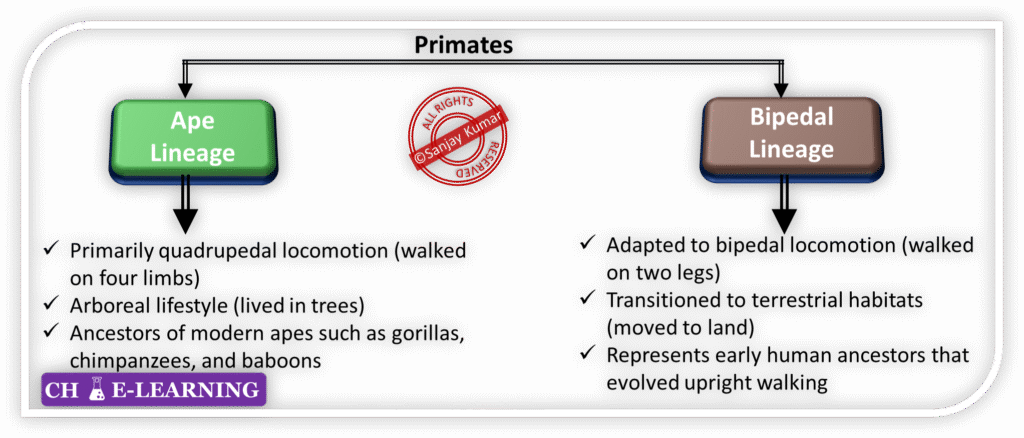
Ape Lineage:::
Ancestors of modern chimpanzees and gorillas.
Bipedal Hominin:::
The first primate to walk on two legs instead of four legs.
- Australopithecus (ऑस्ट्रेलोपिथेकस) emerged first, appearing in Africa around 4−2 million years ago.
- Homo Habilis appeared around 2.5−1.5 million years ago, using stone tools, with a brain size of around 600 g.
- Homo Erectus appeared around 1.9 million–110k years ago, had a larger brain, mastered the use of fire, and exhibited long-term survival.
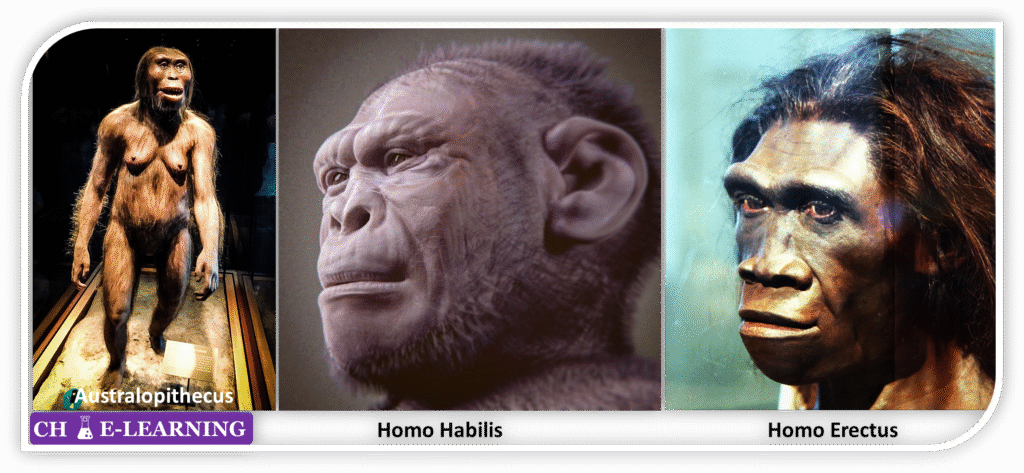
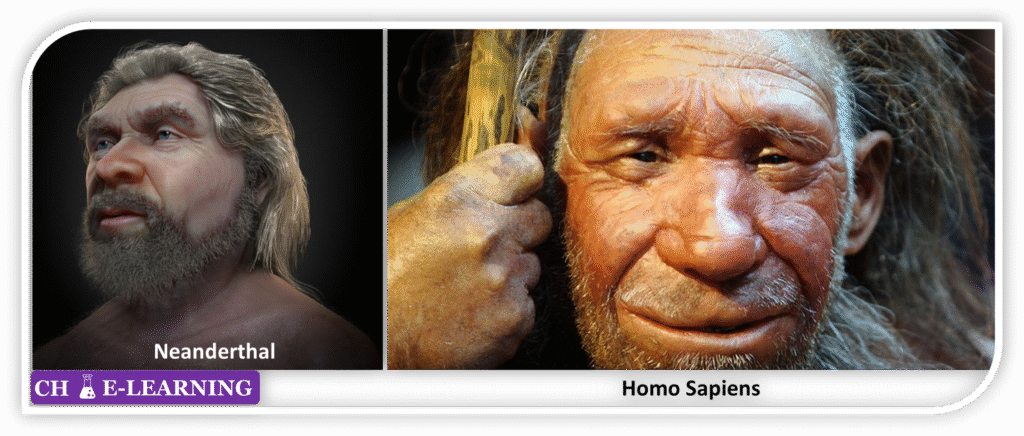
- Neanderthal (निएंडरथल) evolved much later, lived in Europe and western Asia from approximately 400k−40k years ago, before eventually going extinct.
- Homo Sapiens emerged around 300k years ago, with a cranial capacity of 1260 cm3 for males and 1170 cm3 for females.
Cognitive Revolution & Social Revolution::
- The cognitive revolution occurred around 70k years ago, when Homo Sapiens developed language, abstract thought, and imagination (as discussed by Yuval Noah Harari in his book).
- The Neolithic Revolution around 12k years ago marked the agricultural transition.
- The humans shifted from hunting, gathering, and nomadic tribe life (घुमंतु जनजातियाँ / खानाबदोश जनजातियाँ) to settled farming communities.
- Surplus food enabled the rise of social hierarchies, culture, and organized religion.
Brain Development::
- The average brain size of modern humans is about 1,350 g (1260–1350 cm³ for males; 1130–1170 cm³ for females).
- Intelligence development depends on the brain-to-body size ratio.
- The prefrontal cortex plays a central role in generating abstract, creative, and ethical ideas.
Human Society and the Emergence of Philosophy::
The Neolithic Revolution provided food security and leisure, enabling humans to reflect on existence, morality, and knowledge. This paved the way for the development of philosophical systems (darśana).
- In India, the darśanas traditions developed during the Vedic and Upanishadic periods, approximately 3,000–4000 years ago.
- In the West, the first recorded philosopher is Thales of Miletus (6th century BCE, about 2,600 years ago).
- Both India and Greece became major centers of early philosophical and scientific thought.
- Thinkers in India (the ṛṣis ऋषि of the Upanishads) and in Greece (the early philosophers) wrestled with fundamental questions:
- Who am I?
- From where have I come?
- What is the nature of reality?
- Is there rebirth?
These inquiries laid the foundation of metaphysics, epistemology, and ethics.
Branches of Philosophy
The philosophy, often regarded as the mother of discipline, provides the foundational frameworks that underpin the sciences, religion, arts, and social thought.
- It is the systematic inquiry into fundamental questions about reality, knowledge, and value.
- The major branches of philosophy are divided into three categories:
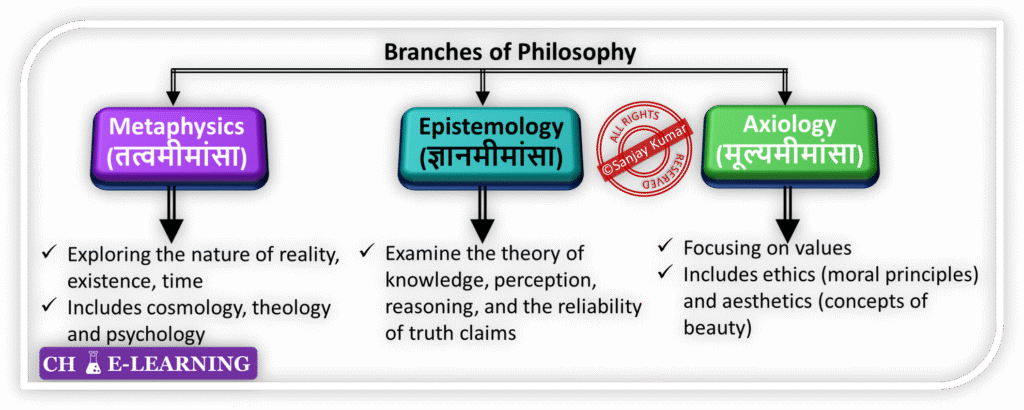
Metaphysics:
It is the branch of philosophy concerned with the nature of reality, existence, and the origin of the world, the possibility of ultimate entities, relationship between mind and matter.
- It asks fundamental questions such as: What exists? What is real? Why is there something rather than nothing?
- It is subdivided into three domains:
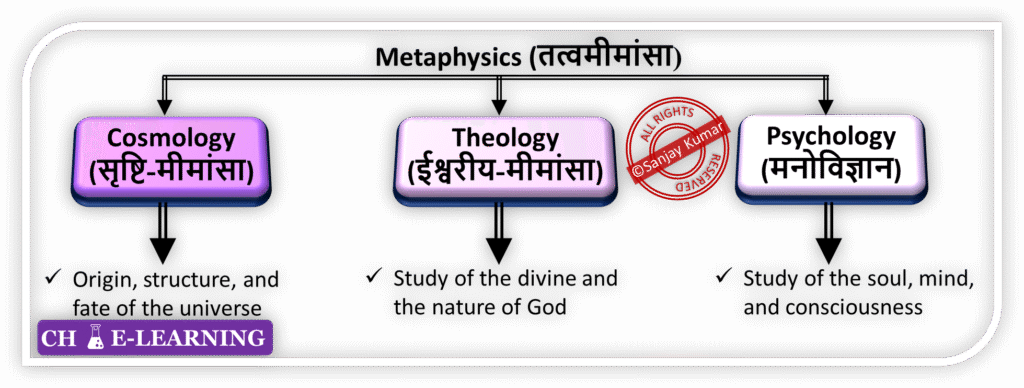
Cosmology::
It is the philosophical study of the universe’s origin, structure, and ultimate fate of the cosmos.
Theology::
It is a study of the divine, the nature of God, and religious belief.
- Theistic Traditions: Hinduism, Islam, and Christianity affirm a creator God.
- Non-theistic Traditions: Jain and Buddhist philosophies reject a creator deity.
- Pantheistic: They identify the divinity within the cosmos itself.
- Agnosticism: They suspend judgement. Immanuel Kant (18th century) argued that we cannot have empirical knowledge of metaphysical entities like God or the soul.
Psychology::
It investigates the soul (atman), mind, consciousness, mind-body relationship.
- Indian darśanas (philosophical schools) such as Sāṅkhya and Vedānta affirm the reality of ātman.
- Jain and Buddhist deny the atman.
- Cārvāka (materialist school) denies the soul, claiming that only the body exists and thinks.
- Extro-mysticism: They seek the spiritual insight in the external world (kān-kān meṃ īśvar).
- Intro-mysticism: They pursue realization through meditation and inner reflection.
Epistemology:
It examines the study of knowledge, belief, and justification. It investigates: What counts as valid knowledge? How do we distinguish truth from illusion? What are the limits of human understanding?
- In Indian traditions recognize multiple pramāṇas (sources of knowledge) such as Pratyakṣa (perception), Anumāna (inference), Śabda (verbal testimony).
Direct perception can be fallible due to illusion (māyā), emotional bias, or altered states (dream, intoxication). Epistemology thus examines logical fallacies and the reliability of reasoning.
Axiology:
It is the philosophical study of values, divided into ethics and aesthetics.
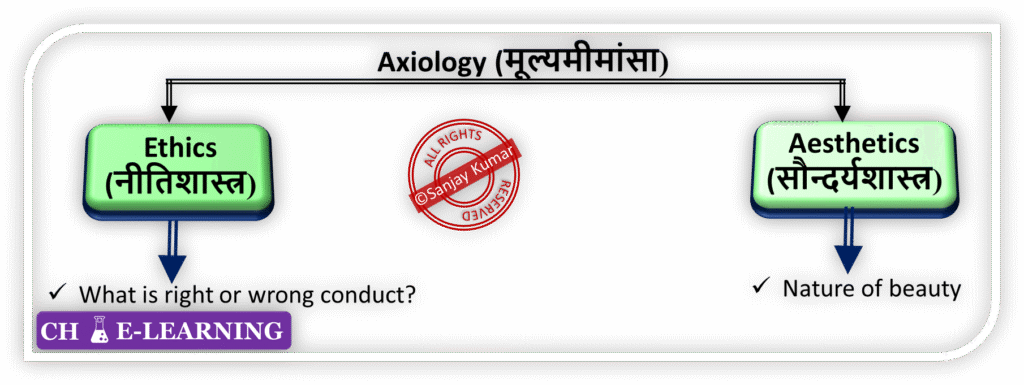
Ethics::
It investigates moral principles, asking what constitutes right action, the nature of moral duties, and a good life.
- Absolutism vs. Relativism: Are moral rules universal or context-dependent?
- Deontology vs. Consequentialism: Do duties or outcomes determine moral worth?
- Virtue Ethics: Should focus lie on moral character and flourishing?
Ethical inquiry also addresses questions such as the flexibility of moral norms, the role of power and wealth, and the ultimate purpose of life.
Aesthetics::
It examines the nature of beauty and art. Major theories of beauty:
- Subjectivism: Beauty resides “in the eye of the beholder.”
- Objectivism: Beauty resides in the object, independent of perception.
- Cultural Relativism: Standards of beauty are shaped by cultural context (e.g., the sari in India, the skirt in the West, the burka in the Middle East).
Indian Philosophical Systems
Indian philosophy comprises diverse schools of thought developed over centuries, aiming to understand reality, self, and liberation.
- These systems are traditionally grouped into two categories: Āstika (orthodox) and Nāstika (heterodox).
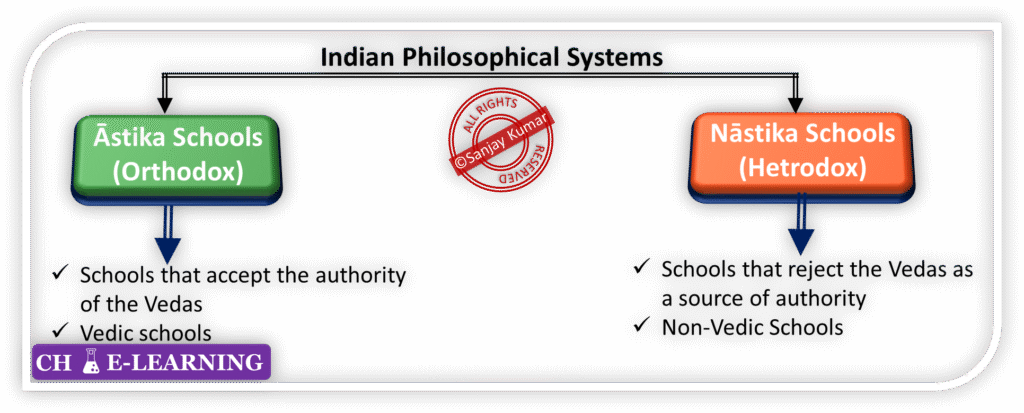
Āstika Schools (Vedic/Orthodox Traditions):
The six classical Āstika darśanas emphasize logic, metaphysics, ritual, and meditation as means to knowledge and liberation:
Nyāya (न्याय): School of logic and epistemology; emphasizes valid means of knowledge (pramāṇas).
Vaiśeṣika (वैशेषिक): Atomistic philosophy; categorization of reality into substances, qualities, and action.
Sāṅkhya (सांख्य): A dualistic system distinguishing Puruṣa (consciousness) and Prakṛti (matter)
Yoga (योग): Practical discipline of meditation, ethics, and self-realization; complements Sāṅkhya
Mīmāṁsā (मीमांसा): Focuses on ritual action (karma) and dharma (duty) as revealed in the Vedas.
Vedānta (वेदांत): Centered on Brahman (ultimate reality), Ātman (self), and liberation; includes sub-schools such as Advaita (अद्वैत), Vishishtadvaita (विशिष्टाद्वैत), and Dvaita (द्वैत).
Nāstika Schools (Non-Vedic/Heterodox Traditions):
These schools reject Vedic authority and develop independent frameworks of ethics, metaphysics, and liberation:
Cārvāka (चार्वाक): Materialistic (भौतिकवादी) philosophy; emphasizes direct perception, rejects afterlife and supernaturalism.
Buddhism (बौद्ध धर्म): Based on impermanence (nothing lasts forever), dependent origination, and the path to liberation through the Four Noble Truths and the Eightfold Path.
Jainism (जैन धर्म): Stresses non-violence (अहिंसा), the relativity of viewpoints (Syādvāda), and the concept of karma as bondage to the soul.