
Why LMTD is used instead of AMTD in a heat exchanger?
In this post, we will explore why the logarithm mean temperature difference (LMTD) is preferred over the arithmetic mean temperature difference (AMTD) when determining the overall heat transfer coefficient in a heat exchanger.
- The overall heat transfer coefficient (Uoverall) is calculated as:
\mathrm{U_{overall}=\frac Q{A\times\triangle T_{LMTD}}}
Where Q is the heat transfer rate, and A is the heat transfer surface area.
Understanding LMTD and AMTD:
LMTD:
It is a mathematical representation of the average temperature difference between the hot and cold fluids across the length of the heat exchanger.
- It is given as:
\mathrm{ \triangle T_{LMTD}=\frac{\triangle T_1-\triangle T_2}{\ln\left({\displaystyle\frac{\triangle T_1}{\triangle T_2}}\right)} }
Where ΔT1 is the temperature difference at one end of the heat exchanger, and ΔT2 is the temperature difference at other end.
- In the heat exchanger, the temperature difference between hot and cold fluid does not remain constant but decreases exponentially along its length.
- LMTD accurately captures this variation in temperature difference.
Special Case: When ΔT1 = ΔT2
If both ends of the heat exchanger have the same temperature difference (i.e., ΔT1 = ΔT2), then LMTD simplifies as follows:
\mathrm{ \triangle T_{LMTD}=\frac{\triangle T_1-\triangle T_1}{\ln\left({\displaystyle\frac{\triangle T_1}{\triangle T_1}}\right)}=\frac00\Rightarrow Undefined }
- In such cases, we assume that the temperature difference remains constant throughout the length of the heat exchanger.
- Thus, LMTD calculation is not required, and LMTD is directly taken as ΔT.
AMTD:
It is the simple arithmetic average of the temperature difference at the ends of a heat exchanger.
- It is given as:
\mathrm{ \triangle T_{AMTD}=\frac{\triangle T_1+\triangle T_2}2 }
- AMTD assumes a linear variation of temperature difference along the length of the heat exchanger, which is not valid in most practical cases.
Temperature Profile in a Heat Exchanger
Co-current Flow Arrangement:
- In a co-current heat exchanger, both hot and cold fluids flow in the same direction.
- The initial temperature difference is large, but it decreases exponentially along the length of the heat exchanger.
- So, the variation in temperature difference along the length of the heat exchanger is nonlinear.

Counter-current Flow Arrangement:
- In a counter-current heat exchanger, hot and cold fluids flow in opposite directions.
- This configuration maintains a more uniform temperature gradient, improving heat exchanger efficiency.
- However, the temperature difference still varies non-linearly along the length of the exchanger.
Comparative Analysis: LMTD vs. AMTD
The following table presents experimental calculations for both co-current and counter-current flow heat exchangers.
| LMTD Calculation (Co-current flow) | |||||||||
| Sr. No. | \mathrm{T_C^{In}(℃) } | \mathrm{T_C^{Out}(℃) } | \mathrm{T_H^{In}(℃) } | \mathrm{T_H^{Out}(℃) } | ΔT1 | ΔT2 | LMTD (°C) | AMTD (°C) | % deviation |
| 1 | 26 | 48 | 64 | 60 | 38 | 12 | 22.56 | 25 | 10.82 |
| 3 | 26 | 39 | 56 | 52 | 30 | 13 | 20.33 | 22 | 8.21 |
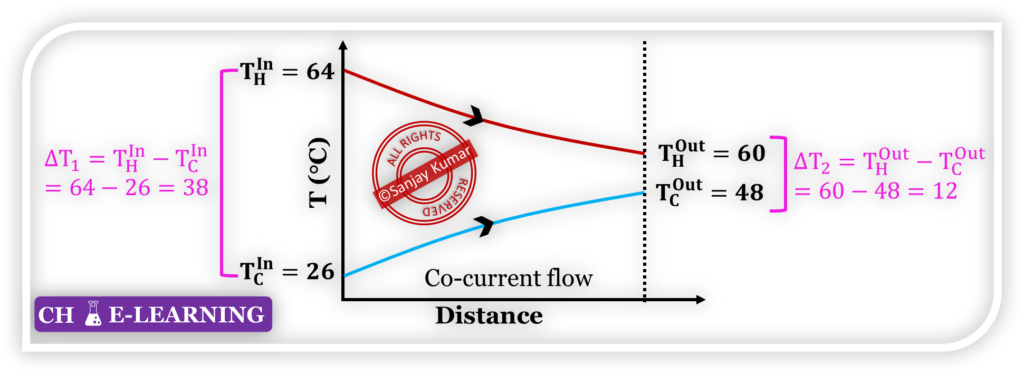
- For the first set of values
\mathrm{ LMTD=\frac{\triangle T_1-\triangle T_2}{\ln\left({\displaystyle\frac{\triangle T_1}{\triangle T_2}}\right)}=\frac{38-12}{\ln\left({\displaystyle\frac{39}{12}}\right)}=22.56\;℃ }
\mathrm{ AMTD=\frac{\triangle T_1+\triangle T_2}2=\frac{38+12}2=25\;℃ }
\mathrm{\%\;deviation=\frac{AMTD-LMTD}{LMTD}\times100=\frac{25-22.56}{22.56}=10.82\;\% }
- This shows AMTD overestimates the temperature difference.
- This overestimate increases as the difference between ΔT1 and ΔT2 increases.
| LMTD Calculation (Counter-current flow) | |||||||||
| Sr. No. | \mathrm{T_C^{In}(℃) } | \mathrm{T_C^{Out}(℃) } | \mathrm{T_H^{In}(℃) } | \mathrm{T_H^{Out}(℃) } | ΔT1 | ΔT2 | LMTD (°C) | AMTD (°C) | % deviation |
| 1 | 30 | 50 | 95 | 85 | 45 | 55 | 49.38 | 50 | 1.26 |
- Here, the deviation is significantly lower. AMTD errors are lower in counterflow but still not negligible.
Conclusion
- LMTD is preferred over AMTD because it accurately represents the nonlinear temperature variation along the heat exchanger length.
- AMTD assumes a linear temperature difference, leading to errors in heat transfer calculations, especially when the inlet and outlet temperature differences vary significantly.
- The error is more pronounced in the co-current flow arrangement compared to counter-current flow.
Thus, LMTD remains the standard for designing and analysing heat exchangers to ensure precise and reliable heat transfer calculations.
Very well presented. Every quote was awesome and thanks for sharing the content. Keep sharing and keep motivating others.
Great information shared.. really enjoyed reading this post thank you author for sharing this post .. appreciated
I am truly thankful to the owner of this web site who has shared this fantastic piece of writing at at this place.
I enjoyed how approachable this article feels. The topic is explained in a straightforward manner without unnecessary complexity. It’s refreshing to read something that feels informative and honest, rather than exaggerated or overly optimized for attention.
Superb post however , I was wanting to know if you could write a litte more on this subject? I’d be very grateful if you could elaborate a little bit more. Appreciate it!
Hi there to all, for the reason that I am genuinely keen of reading this website’s post to be updated on a regular basis. It carries pleasant stuff.